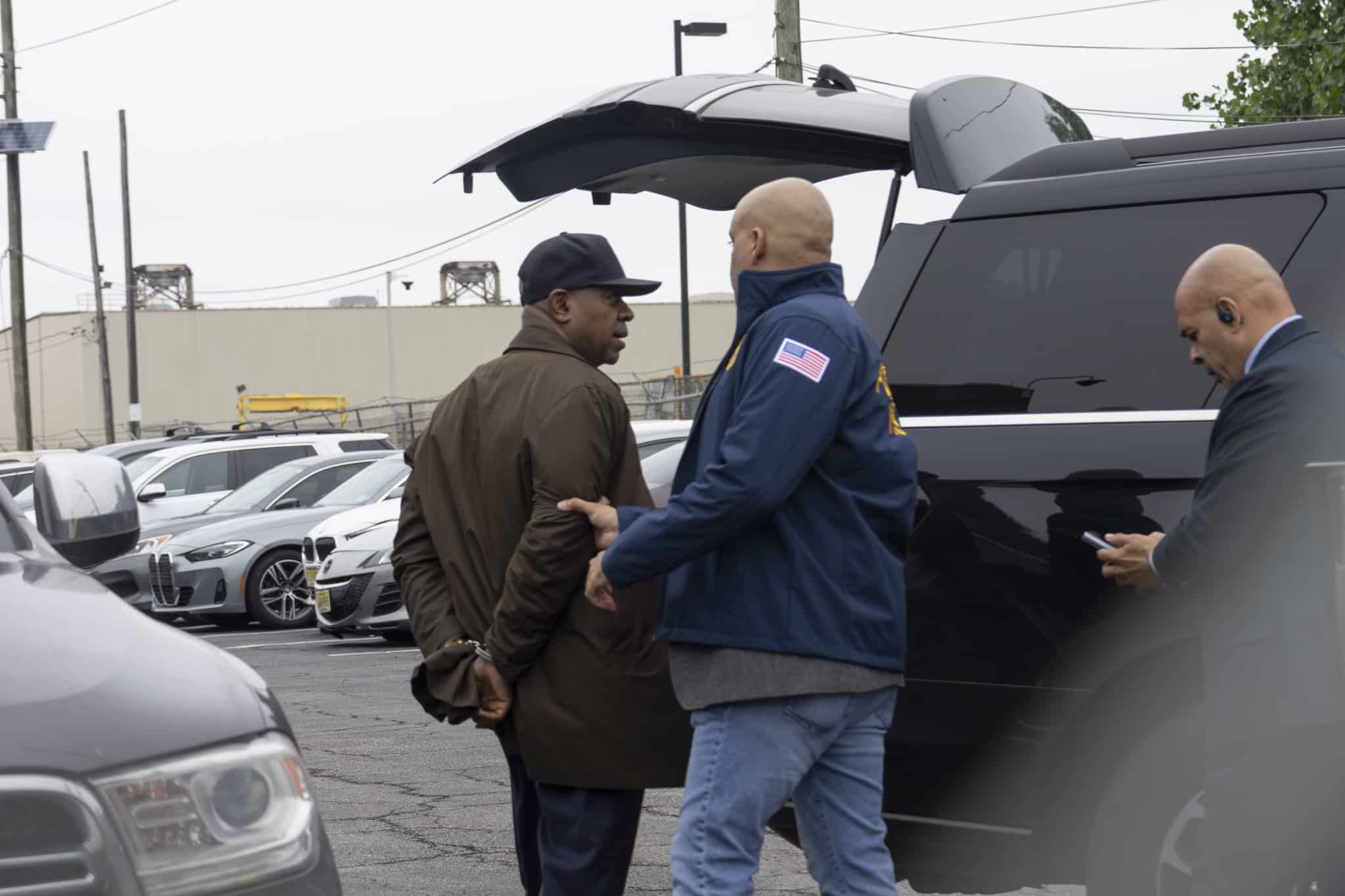
Decades in office, the veteran political figure brought life back to a blighted downtown. In the end, he fought to clear is his name after a corruption conviction.
Newark, N.J. — Former Newark mayor, Sharpe James passed on Monday, May 13 at the age of 89. Both highly revered and reviled by some in his later years, James left a legacy in his five terms serving at the helm of a city belabored with deep-seated issues since its highly publicized 1967 riots.
With only a little over a dozen Black mayors recorded throughout New Jersey’s history, James’ time in office offered a template of leadership in one of the biggest metropolises in the country. “He was a mentor to both Black mayors and others that came behind him. He will be sorely missed. I offer my condolences to his family,” Wayne Smith told Ark Republic. Smith was the mayor of Irvington, New Jersey from 2002 to 2014.
Serving from 1986 to 2006—and during most of this time, he held dual roles as a state senator—James came into power when Newark, a once bustling, industrialized city, plummeted after the industry left. Succeeding the city’s first Black mayor, Kenneth Gibson, James’ focus was to restore the economy by making the city more attractive for small businesses and bringing in development, which sparked a Newark revival movement in the 1990s.
Before James won the mayoral vote, white flight became more visible around the mid-to-late 20th Century; especially following the city’s historical five-day civil unrest. The civil uproar was a response to a number of race-based inequalities and police brutality. It resulted in 26 deaths, over 700 injuries, and significant property damage–a toll heavily shouldered by city residents.
James used his political currency as a former educator, as well as South and Central Ward councilman, to gain backing from his constituents. Included, he appealed to outside investors to pump life into Brick City, a popular sobriquet for the municipality.
During his tenure, revitalization was key. But at times, he bumped heads with local officials and residents. His style of dogged local politics became less effective to younger political aspirants.
“Our relationship included competition, conflict, and collaboration,” recounted Newark’s current Mayor Ras Baraka in a released statement. He continued, “… and through it all, helped define me, my values, and my aspirations for this city. The Newark we live in is, in many ways, a city he created.”
| Read: Voter turnout is paramount in the election, but a ‘Black voter malaise’ shows in New Jersey
In 1994, running for his third term, Baraka ran and lost against the incumbent James. Later on, he took a role in James’ administration as the deputy mayor from 2002 to 2005.
Another former mayor of Newark, Senator Cory Booker (D-NJ), knows all too well the political stalwartness of James. Sen. Booker was defeated when he vied for James’ mayoral position in 2002. The battle by the now-popular New Jersey congressman is explored in his documentary, Street Fight.
When James left office–after being found guilty for a federal land fraud scheme–Booker won against opponent Ronald Rice. The former wrote in a statement that James “was a beloved pillar of our shared community.
In restoring Newark, James poured into revitalizing its downtown district. A section of the city that had been sitting either unused or underdeveloped since the late 60s and early 70s–after businesses fled from the racial unrest and divestment of its white commercial owners. Today, much of his development remains as testament to his work. For instance, if you went to a recent Mary J. Blige concert or saw a hockey game, it was due to the brokering of the long-standing politician.
“In his 20 years in office as Mayor, Sharpe James was many things: a warrior for our city, a unifier for its people, a powerful force to launch development like New Jersey Performing Arts Center and the Prudential Center, and a strong advocate for Newark and its people,” said Baraka.
Newcoming elected congressional official, Rep. LaMonica McIver’s recollection of James was in the same vein, as she noted that his “influence shaped the very identity of our city,” with the development he brought “under his leadership.”
A fall from political grace
Fresh from his retirement as the head-of-Newark, but still a senator, in 2007, James was federally indicted. In 2008, he was found guilty and sentenced to 27 months, plus fined $100,000 for corruption convictions related to a real estate scheme with his mistress, Tamika Riley.
Charges alleged that James allowed Riley to fraudulently obtain deep-discounted, city-owned land. In turn, she resold it for high markups which resulted in hundreds of thousands in profit. Riley was also on the hook for tax fraud and evasion as well as unlawful receipt of rental assistance she was overqualified for. She received a 15-month prison bid.
At the time, Christopher J. Christie was the U.S. attorney who prosecuted the case. Years later, James opined that his conviction “made” Christie, who went on to become the Garden State’s governor and made two attempts at the U.S. presidency.
Once out, James kept voicing his innocence. On the world stage, he was largely a fallen political figure, but locally remained a legend to many. Sharpe, who was in his early 70s when released, could be seen at Newark’s infectious summer outdoor series, Horizon in the City, at the NJPAC performing arts center he worked to build.
“Sharpe was a fixture of New Jersey politics for nearly four decades,” announced outgoing NJ Gov. Phil Murphy, who was endorsed by James when he ran in the 2017 gubernatorial race.
In a statement sent to Ark Republic by Newark’s NAACP the legacy civil rights organization said the following:
On behalf of the NAACP Newark, NJ Branch, we extend our deepest condolences on the passing of former Newark Mayor Sharpe James. A former educator who rose through the ranks of New Jersey local government from South Ward Councilman to Mayor to New Jersey State Senator, Sharpe James was Newark’s most ardent champion. He believed in Newark’s destiny to become a Renaissance City and arduously worked to change the perception of the city he so loved. The fruits of his labor are demonstrated through his many accomplishments.
We thank him for his unwavering dedication to the city of Newark. We thank him for his generous support of the NAACP’s Newark Branch through the Love Newark Foundation. Our prayers are with his family and the many friends he made on his life journey.
James is the third salient New Jersey political figure to pass away within the last two years. First, Lt. Governor Sheila Oliver died on August 2, 2023. Then, Newark’s first female city councilwoman, Mildred Crump, passed on December 1, 2004.
As the condolences pour in, the James family has yet to release details of his funeral arrangements.
Story updated May 14, 2025 at 10:59 p.m.